


That familiar tingling sensation appears, and suddenly your mind starts racing.
Is this another herpes outbreak? Is that small itch a warning sign? Are new blisters about to appear?
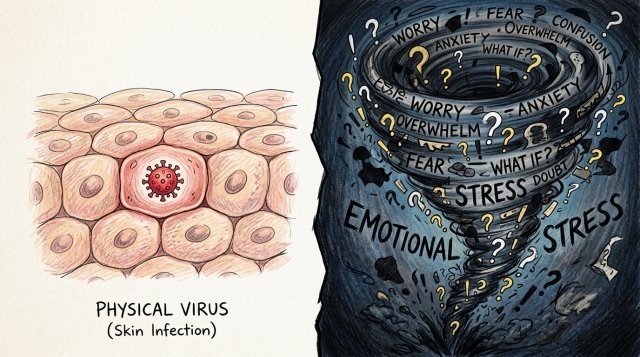
For many people living with HSV-1 or HSV-2, the physical symptoms are only part of the experience. A herpes outbreak may resolve, but the anxiety about when another outbreak might happen can last much longer.
This uncertainty can lead to constantly checking your skin, worrying about every unusual sensation, avoiding intimacy, canceling plans, or feeling anxious about future relationships.
Understanding recurrent herpes, recognizing your individual patterns, and developing a plan for future outbreaks can make the condition feel less unpredictable.
In this article, we’ll explore herpes anxiety, why the fear of another outbreak can become overwhelming, common mistakes that may make that anxiety worse, and practical ways to regain a greater sense of control.
- Why Does Herpes Cause So Much Anxiety?
- Can Anxiety Make You Think You Have Herpes Symptoms?
- Why Am I Constantly Worried About Another Herpes Outbreak?
- Constantly Checking for Herpes Symptoms Can Increase Anxiety
- Can Stress Trigger a Herpes Outbreak?
- Keep a Simple Herpes Outbreak Journal
- Have a Plan Before Your Next Herpes Outbreak
- Can Supplements Help With Herpes Outbreaks?
- When Should You Talk to a Doctor About Frequent Herpes Outbreaks?
- How to Deal With Herpes Anxiety and Fear of Relationships
- How Can I Reduce the Risk of Giving Herpes to My Partner?
- Herpes Doesn't Have to Control Your Daily Life
- Frequently Asked Questions About Herpes Anxiety
Why Does Herpes Cause So Much Anxiety?
Herpes is a viral infection caused by the herpes simplex virus (HSV). After the initial infection, the virus remains in the body and can reactivate.
Some people experience recurrent outbreaks, while others have few noticeable recurrences or none for long periods.
The frequency and severity of outbreaks can vary considerably from person to person.
This unpredictability is one reason herpes can create so much anxiety.
You may not know exactly when another outbreak will occur. As a result, normal sensations that you previously would have ignored can suddenly feel important.
A minor itch may make you wonder whether symptoms are starting.
A tingling sensation may immediately remind you of your previous outbreak.
You may begin examining your skin repeatedly for changes.
Eventually, you can find yourself anticipating the next outbreak even when you currently have no visible symptoms.
Can Anxiety Make You Think You Have Herpes Symptoms?
Anxiety can make you much more attentive to physical sensations.
When you’re worried about another herpes outbreak, sensations such as itching, tingling, sensitivity, or minor skin irritation may receive much more attention than they normally would.
That doesn’t mean every sensation is caused by anxiety. Herpes outbreaks can have prodromal symptoms before lesions develop.
The important distinction is that not every itch, tingle, bump, or unusual skin sensation automatically means another outbreak is beginning.
Constantly checking your body may actually make you notice sensations that you would otherwise barely register.
If you’re uncertain whether recurring symptoms are related to herpes, discussing them with a healthcare professional is more useful than trying to diagnose every sensation yourself.
Why Am I Constantly Worried About Another Herpes Outbreak?
The uncertainty surrounding recurrence can create a cycle.
You experience an outbreak.
You remember how uncomfortable or emotionally difficult it was.
After it disappears, you become determined to recognize the next outbreak immediately.
You begin monitoring your body.
Then you notice something unusual.
That sensation creates anxiety, which makes you pay even more attention to your body.
Eventually, you may spend considerably more time worrying about an outbreak than actually experiencing one.
The goal shouldn’t be to ignore legitimate symptoms. Instead, it should be to recognize meaningful patterns without turning symptom monitoring into constant surveillance.
Constantly Checking for Herpes Symptoms Can Increase Anxiety
One common response to herpes anxiety is trying to control every possible variable.
You might search the internet for hours whenever a new sensation appears.
You might repeatedly examine your skin looking for tiny changes.
You may cancel plans before knowing whether an outbreak is actually developing.
You might begin treating almost every discomfort as evidence that herpes is returning.
These behaviors can initially feel reassuring because they create the impression that you’re being prepared.
But constant monitoring cannot provide complete control over future recurrences.
A better approach is learning what your outbreaks typically look and feel like and knowing what you will do when genuine symptoms appear.
Can Stress Trigger a Herpes Outbreak?
Stress is commonly discussed as a possible factor associated with herpes recurrences, although triggers and outbreak patterns differ considerably between individuals.
Some people report outbreaks during periods of emotional stress, illness, fatigue, or other changes affecting their normal routine.
However, having a stressful day does not automatically mean you’re going to experience an outbreak.
This distinction matters because becoming frightened every time you’re stressed can create another source of anxiety.
Rather than trying to eliminate every possible trigger, it may be more practical to observe whether consistent patterns actually exist in your individual case.
Keep a Simple Herpes Outbreak Journal
One way to identify patterns is keeping a simple record of your outbreaks.
Record when symptoms begin, what symptoms occur, how long they last, and any circumstances that might be relevant.
Over time, this information may help you distinguish genuine recurring patterns from situations you previously assumed were triggers.
The key is keeping the process simple.
You don’t need to inspect your body throughout the day or document every minor sensation.
The purpose of an outbreak journal is to provide useful information, not create another form of daily surveillance.
It can also give you more specific information to discuss with your healthcare professional.
Have a Plan Before Your Next Herpes Outbreak
Uncertainty often becomes easier to manage when you already know what you’re going to do.
Instead of waiting until symptoms appear and then frantically searching the internet for answers, develop a plan beforehand.
For example, discuss with a healthcare professional what symptoms you should watch for, when antiviral medication should be started if prescribed, and whether episodic or suppressive antiviral therapy may be appropriate for your situation.
Starting episodic antiviral treatment promptly can be beneficial for recurrent genital herpes, which is one reason recognizing genuine prodromal symptoms can matter.
For people experiencing frequent recurrences or significant disruption to their quality of life, suppressive antiviral therapy may also be discussed with a healthcare professional.
Having an established plan reduces the number of decisions you need to make when you’re already uncomfortable or worried.
Can Supplements Help With Herpes Outbreaks?
People living with recurrent herpes often search for dietary changes, vitamins, lysine, herbal ingredients, and other supplements that might support their overall health or help them manage recurrences.
Evidence varies substantially depending on the specific supplement or ingredient.
A supplement shouldn’t automatically be considered a replacement for established antiviral treatment, particularly if you’re experiencing frequent, severe, or unusual outbreaks.
If you’re considering a supplement, look at its individual ingredients, available evidence, possible medication interactions, and whether it is appropriate for your circumstances.
It can also be useful to discuss supplement use with a qualified healthcare professional, especially if you take medications or have other medical conditions.
When Should You Talk to a Doctor About Frequent Herpes Outbreaks?
Some people feel embarrassed about discussing herpes, even with healthcare professionals.
That embarrassment can lead them to repeatedly manage symptoms alone.
However, medical guidance becomes particularly important when outbreaks are frequent, unusually painful, changing in appearance or pattern, or significantly affecting your quality of life.
You should also seek professional evaluation when you’re uncertain whether the symptoms you’re experiencing are actually caused by herpes.
Not every genital lesion, rash, bump, itch, or painful sensation is HSV.
Getting an appropriate diagnosis can prevent months of unnecessary uncertainty.
How to Deal With Herpes Anxiety and Fear of Relationships
The emotional effects of herpes don’t necessarily disappear when the physical symptoms disappear.
You might begin avoiding dates because you’re afraid of eventually discussing your diagnosis.
You might distance yourself from potential partners.
Or intimacy may become associated with anxiety rather than connection.
If herpes begins determining where you go, whom you date, or whether you allow yourself to develop relationships, the emotional impact deserves attention too.
Talking about herpes with a partner can initially feel uncomfortable, but the conversation doesn’t have to be framed as a frightening confession.
It can instead be approached as a conversation about health, communication, risk reduction, and shared decision-making.
How Can I Reduce the Risk of Giving Herpes to My Partner?
Understanding transmission can make conversations with partners more practical and less driven by fear.
Avoiding sexual contact when lesions or other outbreak symptoms are present can help reduce transmission risk.
Condoms can also reduce the risk of genital herpes transmission, although they cannot eliminate it because HSV can be transmitted from skin not covered by a condom.
For some people, daily suppressive antiviral medication may further reduce transmission risk.
The appropriate strategy depends on factors such as HSV type, outbreak history, location of infection, relationship circumstances, and individual medical considerations.
A healthcare professional can help you understand which risk-reduction strategies are appropriate for you.
Herpes Doesn’t Have to Control Your Daily Life
Having herpes doesn’t mean every unusual sensation needs to become an emergency.
It doesn’t mean you need to cancel plans whenever you feel an itch.
And it doesn’t mean intimacy must permanently become a source of fear.
The physical condition deserves appropriate management, but its emotional impact deserves attention as well.
Regaining a sense of control often begins by replacing constant uncertainty with reliable information.
Then that information needs to become a realistic plan that fits your individual situation.
Learn your genuine outbreak patterns.
Know what you’ll do if symptoms return.
Talk with a healthcare professional when something changes.
And pay attention to whether the fear of herpes is beginning to interfere with your relationships, intimacy, social life, or everyday decisions.
Managing herpes isn’t only about what happens during an outbreak. It’s also about how much control you allow the possibility of another outbreak to have over the days when you’re feeling well.
Frequently Asked Questions About Herpes Anxiety
Why am I so anxious about having herpes?
Herpes can create anxiety because outbreaks are recurrent and their timing isn’t always predictable. Concerns about symptoms, transmission, relationships, disclosure, and future outbreaks can make some people think about the infection even when they aren’t experiencing symptoms.
How do I stop worrying about herpes all the time?
Learning your typical outbreak pattern, limiting repetitive symptom checking, using reliable health information, developing an outbreak plan with a healthcare professional, and addressing persistent anxiety can help. If worry is interfering with relationships, work, sleep, intimacy, or everyday activities, consider discussing the emotional impact with a qualified professional.
Can anxiety cause herpes symptoms?
Anxiety can increase awareness of normal physical sensations and make itching, tingling, or minor irritation feel more significant. However, herpes itself can also produce symptoms such as tingling or discomfort. Persistent or uncertain symptoms should be evaluated rather than automatically attributed to either herpes or anxiety.
Can stress cause a herpes outbreak?
Stress is reported as a potential trigger for recurrent herpes in some people, but triggers vary between individuals. Experiencing stress doesn’t mean an outbreak will necessarily occur.
Does tingling always mean a herpes outbreak is coming?
No. Tingling can occur as a prodromal symptom before some herpes outbreaks, but tingling has many possible causes. Learning your individual pattern can make it easier to recognize symptoms that consistently precede your outbreaks.
Why do I keep checking myself for herpes symptoms?
Repeated checking can develop from fear of missing the beginning of another outbreak. Although checking may temporarily reduce uncertainty, excessive monitoring can keep your attention focused on minor physical sensations and potentially reinforce anxiety.
How do I know if herpes is coming back?
Some people experience warning symptoms such as tingling, itching, burning, sensitivity, or discomfort before recurrent lesions appear. Patterns vary between individuals, so keeping a simple record of confirmed outbreaks can help you understand your own typical warning signs.
Can herpes anxiety affect relationships?
Yes. Fear of transmission, rejection, disclosure, or another outbreak can affect dating and intimacy. Accurate information about HSV and open communication about transmission and risk reduction can help partners make informed decisions together.
Should I take daily antivirals if I’m scared of another herpes outbreak?
Suppressive antiviral therapy can be appropriate for some people with recurrent herpes, but the decision should be individualized. A healthcare professional can consider your outbreak frequency, severity, quality-of-life impact, transmission concerns, and medical history.
What should I do if I have frequent herpes outbreaks?
If outbreaks remain frequent, severe, unusually painful, or disruptive to your quality of life, talk with a healthcare professional. They can confirm whether the symptoms are HSV-related and discuss treatment approaches, including episodic or suppressive antiviral therapy.
Can supplements prevent herpes outbreaks?
Evidence depends on the specific supplement and ingredients, and supplements shouldn’t automatically be treated as substitutes for established herpes treatments. Review the evidence for individual ingredients and discuss supplement use with a healthcare professional when appropriate.
Can I have a normal relationship if I have herpes?
Yes. Having HSV doesn’t prevent someone from dating, developing relationships, or having an intimate life. Understanding transmission, discussing the infection with partners, recognizing symptoms, and using appropriate risk-reduction strategies can make decisions surrounding intimacy more informed and manageable.